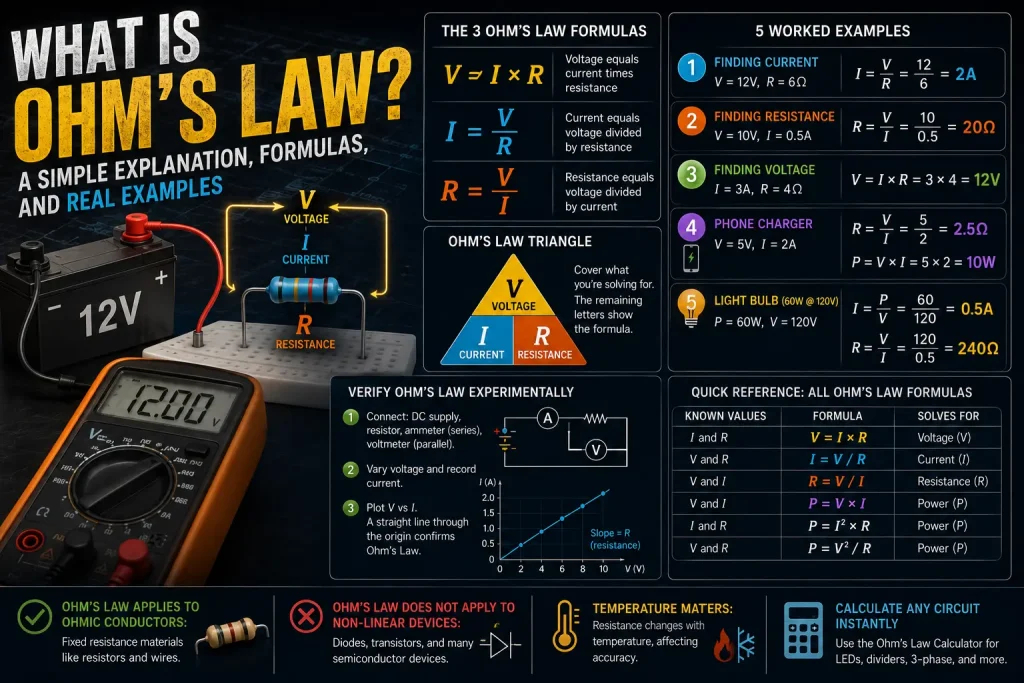
Ohm’s Law describes one fixed relationship: voltage pushes current through a circuit, and resistance holds it back. Increase the voltage, and current goes up. Increase the resistance, and current goes down. That’s the entire idea; everything else is just the math that makes it precise enough to design real circuits with.
This guide breaks Ohm’s Law down in plain terms, walks through five worked examples using different starting values, explains where the law came from, and shows how to verify it yourself with basic equipment. For the full technical treatment- AC circuits, LED resistor sizing, three-phase power, speaker impedance- the Ohm’s Law Calculator covers that in depth; this article is the plain-language foundation underneath it.
What Is Ohm’s Law in Simple Terms?
Ohm’s Law says the current flowing through a circuit equals the voltage divided by the resistance: I = V/R. Nothing about it depends on outside comparisons or mental pictures; it’s a direct, fixed ratio between three measurable quantities.
Voltage is the electrical push about how hard the source drives current through the circuit, measured in volts (V). Current is the actual flow- how much electric charge moves per second, measured in amperes (A). Resistance is whatever slows that flow down, measured in ohms (Ω). Ohm’s Law ties all three together in one formula, and knowing any two always gives you the third.
The 3 Ohm’s Law Formulas Explained
Ohm’s Law has three formulas, and each one just rearranges the same relationship to solve for a different unknown.
| To find | Formula | In words |
|---|---|---|
| Voltage (V) | V = I × R | Voltage equals current times resistance |
| Current (I) | I = V / R | Current equals voltage divided by resistance |
| Resistance (R) | R = V / I | Resistance equals voltage divided by current |
Pick whichever formula matches the two values you already know, and the third comes out directly, no rearranging needed once you’ve matched the right version.
Power is a separate but closely related set of formulas, and it’s worth knowing the distinction. Power comes from Joule’s Law, not Ohm’s Law directly, though the two combine constantly in practice:
| To find | Formula |
|---|---|
| Power (P) | P = V × I |
| Power (P) | P = I² × R |
| Power (P) | P = V² / R |
Any one of these three power formulas works once you know the right pair of values; which one you use just depends on which two quantities you already have.
The Ohm’s Law Triangle
The Ohm’s Law triangle is a memory aid that arranges V, I, and R so you can find any formula by covering up the value you’re solving for.
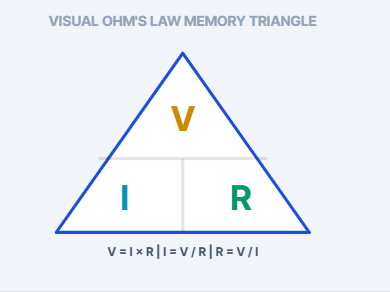
Cover V, and I sits next to R, giving V = I × R. Cover I, and V sits over R, giving I = V/R. Cover R, and V sits over I, giving R = V/I. It’s not a law itself, just a quick way to avoid mixing up which value goes on top. The Ohm’s Law Calculator includes an interactive version of this triangle if you want to click through the formulas directly.
Ohm’s Law Examples: 5 Worked Problems
Each example below starts from a different pair of known values, since that’s exactly how Ohm’s Law gets used in practice; you rarely know all three numbers before you calculate.
Example 1: finding current. A 12V battery connects to a 6Ω resistor. What’s the current? I = V/R = 12/6 = 2A.
Example 2: finding resistance. A component draws 0.5A when connected to a 10V source. What’s its resistance? R = V/I = 10/0.5 = 20Ω.
Example 3: finding voltage. A circuit pushes 3A through a 4Ω resistor. What’s the voltage across it? V = I × R = 3 × 4 = 12V.
Example 4: a phone charger. A standard 5V USB charger delivers 2A to a phone. The phone’s charging circuit presents an effective resistance of R = V/I = 5/2 = 2.5Ω, and it draws power of P = V × I = 5 × 2 = 10W.
Example 5: a household light bulb. A 120V incandescent bulb is rated at 60W. Current draw is I = P/V = 60/120 = 0.5A, and the bulb’s resistance while lit is R = V/I = 120/0.5 = 240Ω.
Every one of these problems starts with two known values and ends with the third; try your own numbers in the Ohm’s Law Calculator to check any circuit you’re working on.
Is Ohm’s Law Easy?
Yes, Ohm’s Law is one of the easier concepts in basic physics or electronics; the formula itself is simple division and multiplication, and it only takes practice with a handful of examples to use confidently.
Where people get tripped up isn’t the math — it’s remembering which formula to use for which known values, and knowing when Ohm’s Law stops applying at all (more on that below). Once both of those click, the calculation itself is straightforward.
Who Discovered Ohm’s Law?
According to Wikipedia, Georg Simon Ohm, a German physicist, published the relationship between voltage, current, and resistance in 1827, in a book titled Die galvanische Kette, mathematisch bearbeitet (“The Galvanic Circuit Investigated Mathematically”).
Ohm was working as a secondary school teacher in Cologne at the time, without major institutional funding, and built much of his own experimental apparatus. He tested wires of different lengths and thicknesses under varying voltage, using a stable voltage source and a current-measuring device to record how the two quantities related to each other.
Ohm’s work was met with skepticism in Germany when it was first published, and broader recognition came only later in his career. The Royal Society awarded him the Copley Medal in 1841, and he was appointed to a physics chair at the University of Munich in 1852, two years before his death in 1854. The ohm (Ω), the standard unit of electrical resistance, now carries his name, a permanent record of a relationship that took over a decade to gain the recognition it deserved.
How to Verify Ohm’s Law Experimentally
You can verify Ohm’s Law with four basic pieces of equipment: a DC power supply, a fixed resistor, an ammeter, and a voltmeter.
Connect the resistor to the power supply with the ammeter in series (in the same current path) and the voltmeter in parallel across the resistor (measuring the voltage drop directly). Set the power supply to a series of different voltages, say 2V, 4V, 6V, 8V, and 10V, and record the current at each setting.
Plot voltage on one axis and current on the other. A straight line passing through the origin confirms ohmic behavior, and the slope of that line equals the resistance value, matching R = V/I. If the line curves instead of staying straight, the component isn’t behaving as a simple ohmic resistor — which is exactly what happens with components like diodes, covered in the limitations section below.
Applications and Limitations of Ohm’s Law
Ohm’s Law governs current flow anywhere a circuit uses a fixed resistance, sizing resistors, predicting battery drain, calculating voltage drop over long wires, and distributing power across an electrical grid. The Ohm’s Law Calculator covers these applications in full depth, including LED circuit design, speaker impedance matching, and three-phase power systems.
The law has real limits, though. It applies to ohmic conductors, materials like copper wire and standard resistors that hold a fixed resistance regardless of the voltage applied. It breaks down for non-linear devices like diodes and transistors, where resistance itself changes with the applied voltage, and it loses accuracy as temperature shifts push a component’s actual resistance away from its rated value.
Quick Reference: All Ohm’s Law Formulas at a Glance
This table serves those who are looking for an Ohm’s Law PDF.
| Known values | Formula | Solves for |
|---|---|---|
| I and R | V = I × R | Voltage |
| V and R | I = V / R | Current |
| V and I | R = V / I | Resistance |
| V and I | P = V × I | Power |
| I and R | P = I² × R | Power |
| V and R | P = V² / R | Power |
Bookmark this table as your quick reference, or use the Ohm’s Law Calculator to skip the manual math entirely and get the answer directly from any two known values, including support for voltage dividers and resistor identification through the site’s related tools.
Frequently Asked Questions
What is Ohm’s law in simple terms?
Ohm’s Law states that current equals voltage divided by resistance (I = V/R). Raise the voltage and current increases; raise the resistance and current decreases, assuming the other value stays fixed.
What are the 3 Ohm’s law formulas?
The three formulas are V = I × R (voltage), I = V/R (current), and R = V/I (resistance). Each one solves for a different unknown using the other two known values.
What does Ohm’s law state?
Ohm’s Law states that current through a conductor is directly proportional to voltage and inversely proportional to resistance, for conductors that hold a constant resistance regardless of applied voltage.
Is Ohm’s law easy?
Yes, the math behind Ohm’s Law is simple multiplication and division. The main challenge is remembering which formula matches which known values and recognizing when the law doesn’t apply, not the calculation itself.
Who discovered Ohm’s law, and when?
Georg Simon Ohm, a German physicist, published the relationship in 1827 in Die galvanische Kette, mathematisch bearbeitet, based on his own experiments measuring current through wires of varying length and thickness under different voltages.
What are the limitations of Ohm’s law?
Ohm’s Law only applies to ohmic conductors under stable temperature conditions. It doesn’t hold for non-linear devices like diodes and transistors, since their resistance changes with the voltage applied rather than staying fixed.