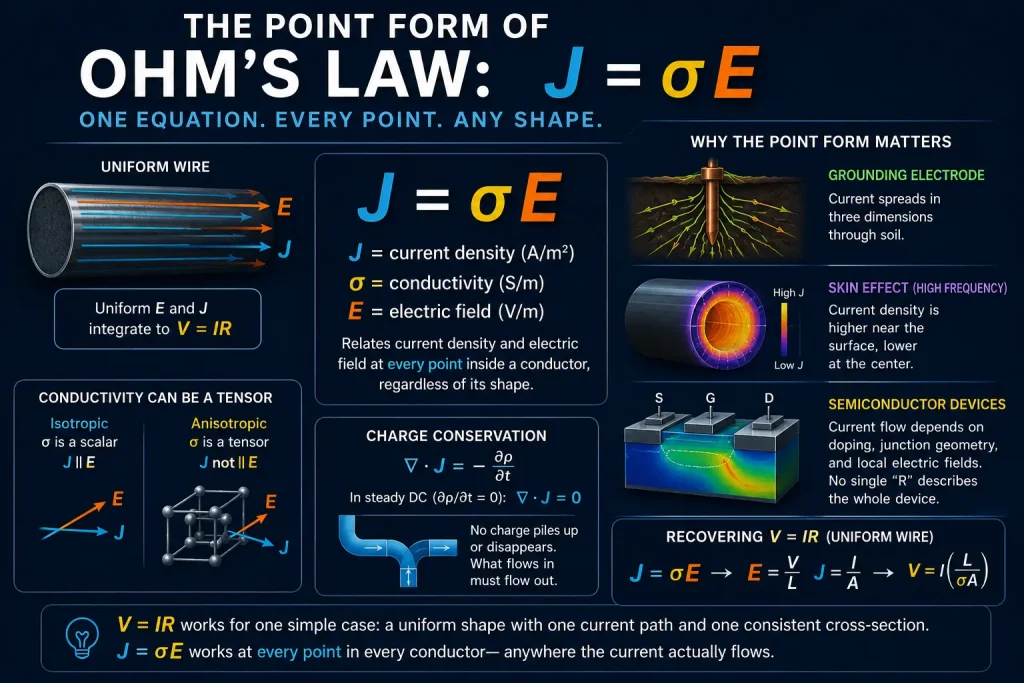
The equation V = IR only works for a specific, uniform shape: a wire or resistor with one current path and one consistent cross-section. Real conductors are rarely that simple. The point form of Ohm’s Law, J = σE, describes current flow at every individual point inside a material, regardless of its shape, making it the version physicists and engineers actually need for anything beyond a straight wire.
This article builds on the derivation in Where Does Ohm’s Law Come From?, which shows exactly how J = σE turns into V = IR for a uniform wire. Here, the focus is on why the point form exists separately, and where it’s genuinely necessary.
What J = σE Actually Says
J = σE relates current density and electric field at a single point inside a conductor, rather than describing current and voltage across the conductor as a whole.
J is current density, a vector describing how much current flows through a unit area, and in which direction. E is the electric field vector at that same point. σ is the material’s conductivity, a property of the material itself, not of its shape. Multiply the field by the conductivity, and the result is the current density at that exact location.
This is fundamentally more general than V = IR, because it doesn’t assume the field is uniform or that current flows along one simple path. It holds true at every point inside any conductor, no matter how oddly shaped.
Conductivity Can Be a Tensor, Not Just a Number
In most everyday materials, conductivity behaves as a single number, the same in every direction. In some crystalline materials, it doesn’t.
Copper, aluminum, and most metals used in wiring are isotropic: their conductivity is identical regardless of which direction the current flows through them, so σ is a simple scalar and J = σE points in the same direction as E.
Some crystals are anisotropic; their internal atomic structure conducts differently along different axes. In these materials, σ becomes a tensor (a 3×3 matrix relating the components of J to the components of E), and current doesn’t necessarily flow in the same direction as the applied field. This distinction rarely matters for standard circuit components, but it matters directly in semiconductor device physics and materials engineering, where crystal orientation affects real device performance.
Why the Point Form Matters in Practice
Any situation where current doesn’t flow uniformly through a simple shape needs the point form, not V = IR.
Grounding electrodes are a direct example: current spreads out from a ground rod into the surrounding soil in three dimensions, not along one path, so calculating fault current distribution requires J = σE applied across the electrode’s real geometry.
High-frequency AC circuits show a related effect called the skin effect: at high frequencies, the changing magnetic field inside a conductor induces internal currents that oppose current flow at the center of the wire, pushing current density higher near the surface. The result is a non-uniform J throughout the conductor’s cross-section, something V = IR, which assumes one uniform current, simply can’t describe. The point form can.
Semiconductor devices are the other major case. Current flow inside a transistor or diode isn’t uniform through a simple cross-section; it depends on doping concentration, junction geometry, and local electric fields that vary throughout the device. Device engineers work directly with J = σE (and its semiconductor extensions) because there’s no single “R” that describes the whole component. Why Diodes Don’t Follow Ohm’s Law covers exactly this case.
The Connection to Charge Conservation
J = σE connects to a deeper principle in electromagnetism: charge conservation, expressed through the continuity equation.
The continuity equation states that charge can’t appear or disappear; it states ∇·J = −∂ρ/∂t, meaning the divergence of current density at any point equals the rate at which charge density decreases there. In a steady DC circuit, charge density isn’t changing anywhere (∂ρ/∂t = 0), which means ∇·J = 0: current density has zero divergence, the same mathematical condition that describes an incompressible fluid.
That’s a genuinely useful way to think about steady current flow, like water through a network of pipes; current in a DC circuit doesn’t pool up or vanish at any point; whatever flows in somewhere must flow out somewhere else. J = σE, combined with this conservation law, is what lets engineers solve for current distribution in complex conductor geometries where a simple series/parallel circuit model doesn’t apply.
Recovering V = IR, the Short Version
Integrate J = σE along a uniform wire’s length, and the familiar V = IR formula falls straight out of it. The full derivation, including a worked numerical example using copper’s actual conductivity, is in Where Does Ohm’s Law Come From? This piece exists to explain why that simplification is only valid for uniform geometries, and what to reach for when it isn’t.
For everyday circuit work involving straightforward wires and resistors, that simplification is exactly right, and the Ohm’s Law Calculator applies it directly. A common real-world use of the simple V = IR form is a voltage divider, two resistors in series, uniform current throughout, no need for the point form at all.