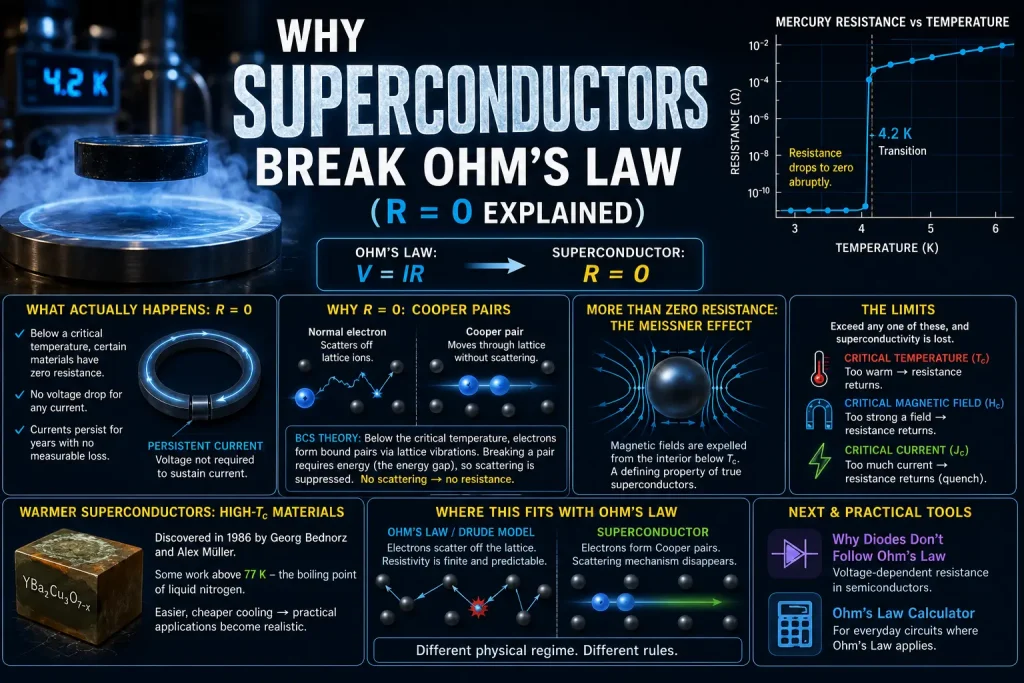
A superconductor’s resistance doesn’t get very low; it drops to exactly zero. Below a specific critical temperature, certain materials carry electric current with no measurable resistance at all, no energy loss, and no voltage drop across them regardless of how much current flows. That’s not an extreme case of Ohm’s Law; it’s a complete departure from the physical assumptions the law depends on.
This is the clearest possible case of Ohm’s Law breaking down, and understanding why connects directly back to the Drude model derivation, since superconductivity removes the exact mechanism, electron scattering, that derivation relies on.
What Actually Happens When R = 0
In Ohm’s Law terms, a superconductor has R = 0, which means V = IR predicts zero voltage drop for any current, no matter how large. That’s exactly what’s observed: current flows through a superconducting loop with no driving voltage needed to sustain it, and no energy dissipated as heat.
This was first observed by Heike Kamerlingh Onnes in 1911, while studying mercury cooled with liquid helium. Mercury’s resistance didn’t just decrease as it cooled; it dropped abruptly to an unmeasurable value at about 4.2 Kelvin, just above absolute zero. Persistent-current experiments since then, running current in a superconducting loop and watching for any decay, have found currents that persist for years without measurable loss, consistent with resistance that is genuinely zero, not just extremely small.
Why R = 0: Cooper Pairs
Superconductivity happens because electrons stop scattering individually and instead move through the material in bound pairs, called Cooper pairs, that travel without the resistance-causing collisions normal electrons experience.
The explanation comes from BCS theory (Bardeen, Cooper, and Schrieffer, 1957). Below the critical temperature, electrons in a superconductor pair up through an indirect attraction mediated by the crystal lattice: one electron slightly distorts the lattice as it passes, and that distortion attracts a second electron, creating a weak but real bound pair.
This matters directly for the Drude picture of resistance. Normal resistance comes from individual electrons scattering off the lattice and losing their drift velocity, over and over, roughly every 10⁻¹⁴ seconds in a metal like copper. Breaking apart a Cooper pair to scatter one of its electrons costs energy; there’s an energy gap between the paired state and a broken one. Below the critical temperature, the thermal energy available isn’t enough to break these pairs for the vast majority of them, so the paired electrons move through the lattice without the scattering that normally causes resistance. No scattering means no relaxation time in the Drude sense, which means the entire mechanism behind σ = ne²τ/m no longer applies the way it does in an ordinary metal.
Superconductivity Is More Than Just Zero Resistance
A superconductor doesn’t just conduct with zero resistance; it also expels magnetic fields from its interior, a separate phenomenon called the Meissner effect.
Walther Meissner and Robert Ochsenfeld discovered this in 1933: a material cooled below its critical temperature actively pushes external magnetic field lines out of its interior, rather than simply allowing current to flow with no resistance. This distinguishes a true superconductor from a hypothetical “perfect conductor” with zero resistance, but no such field expulsion; the two would behave differently under an applied magnetic field, and only real superconductors show the Meissner effect. It’s the property that makes magnetic levitation demonstrations possible, and it’s a defining feature of superconductivity, not a side effect of zero resistance.
The Limits: Critical Temperature, Field, and Current
Superconductivity only holds below three separate thresholds: critical temperature, critical magnetic field, and critical current density, and exceeding any one of them destroys the effect.
Push a superconductor’s current too high, or expose it to too strong a magnetic field, or let its temperature drift above the critical point, and it reverts to normal, ohmic resistance immediately. In superconducting magnets, this reversion is called a quench, resistance suddenly reappearing in a conductor carrying enormous current, generating a sudden and significant amount of heat where a moment earlier there was none. Real superconducting systems, from MRI magnets to particle accelerators, are engineered specifically around staying safely below all three limits at once.
Warmer Superconductors: High-Tc Materials
Original superconductors needed liquid helium, cooling to around 4 Kelvin, a major practical barrier. Materials discovered in 1986 work at far higher, though still cold, temperatures.
Georg Bednorz and Alex Müller, working at IBM Zurich, discovered a class of ceramic copper-oxide materials that became superconducting at temperatures well above anything previously known, work that earned them the Nobel Prize in Physics in 1987. Some of these high-temperature superconductors work above 77 Kelvin, the boiling point of liquid nitrogen, which is dramatically cheaper and easier to handle than liquid helium, making practical applications far more accessible than the original mercury-based discovery ever allowed.
Where This Fits With Ohm’s Law
Ohm’s Law describes materials where resistance stays fixed and current scatters against a lattice in a predictable, temperature-dependent way, the exact physical picture in the Drude derivation. Superconductivity isn’t an extreme version of that picture; it’s a different physical regime where the scattering mechanism itself disappears.
The other major case where Ohm’s Law breaks down works differently, not through zero resistance, but through resistance that depends on the applied voltage itself. That’s covered in Why Diodes Don’t Follow Ohm’s Law, the semiconductor counterpart to this superconducting extreme. For where Ohm’s Law does apply reliably, everyday resistors, wires, and circuit components, the Ohm’s Law Calculator covers the practical calculations directly.