Engineering Blog & Physics Guides

Electronics tutorials, circuit design insights, and physics articles written by Muzammal Amin.

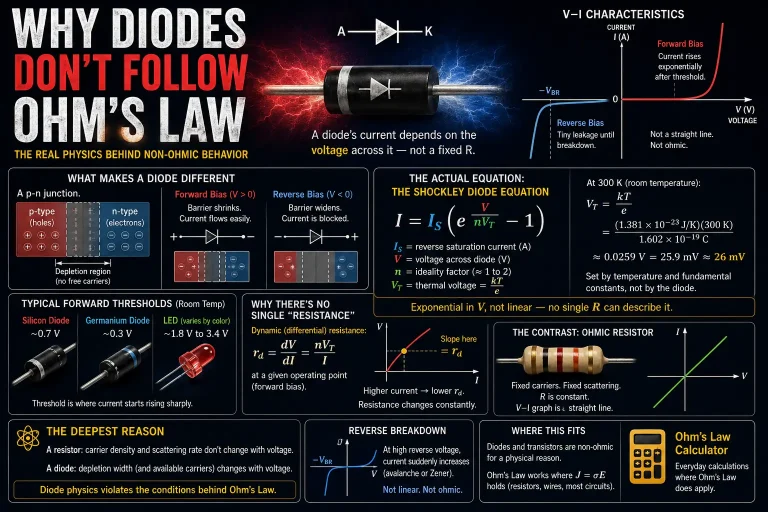
Why Diodes Don't Follow Ohm's Law

Why Diodes Don’t Follow Ohm’s Law

A diode’s resistance isn’t fixed; it changes depending on how much voltage is across it, which is exactly why Ohm’s Law can’t describe one with a single R value. Where a resistor’s V/I ratio stays constant no matter what voltage you apply, a diode’s current rises exponentially once forward voltage crosses a threshold, and drops […]
Read Article →
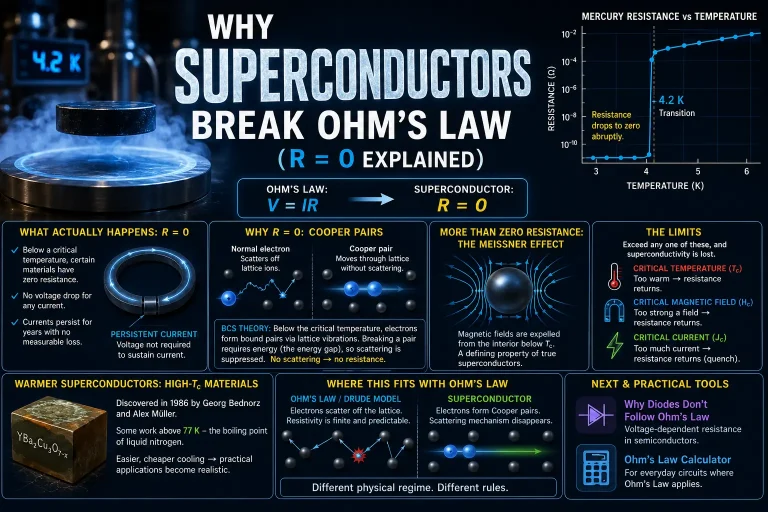
Why Superconductors Break Ohm's Law

Why Superconductors Break Ohm’s Law

A superconductor’s resistance doesn’t get very low; it drops to exactly zero. Below a specific critical temperature, certain materials carry electric current with no measurable resistance at all, no energy loss, and no voltage drop across them regardless of how much current flows. That’s not an extreme case of Ohm’s Law; it’s a complete departure […]

Read Article →
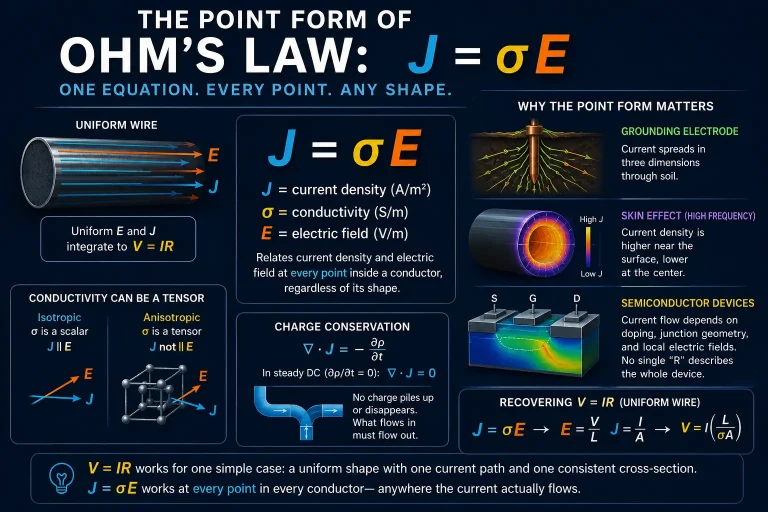
The Point Form of Ohm's Law

The Point Form of Ohm’s Law: J = σE

The equation V = IR only works for a specific, uniform shape: a wire or resistor with one current path and one consistent cross-section. Real conductors are rarely that simple. The point form of Ohm’s Law, J = σE, describes current flow at every individual point inside a material, regardless of its shape, making it […]

Read Article →
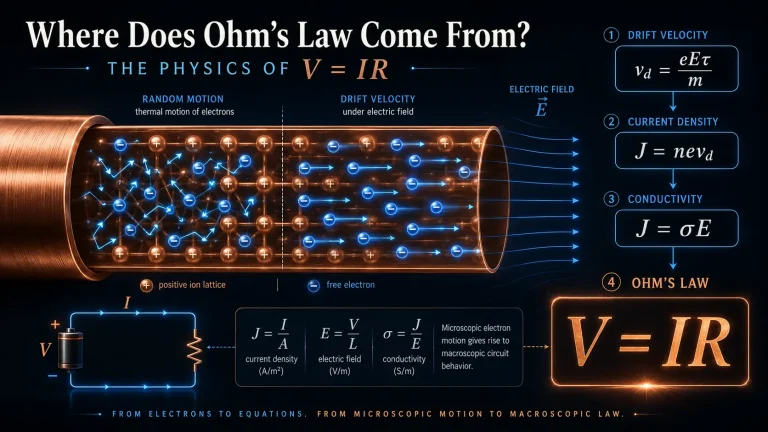
Where does ohm law comes from

Where Does Ohm’s Law Actually Come From? The Physics Behind V = IR

Ohm’s Law isn’t a starting assumption; it’s a consequence of how electrons actually move through a metal. This article derives V = IR from the physics of electron motion itself, using the Drude model, the same framework physicists use to explain why metals conduct electricity the way they do. If you haven’t read the plain-language […]

Read Article →
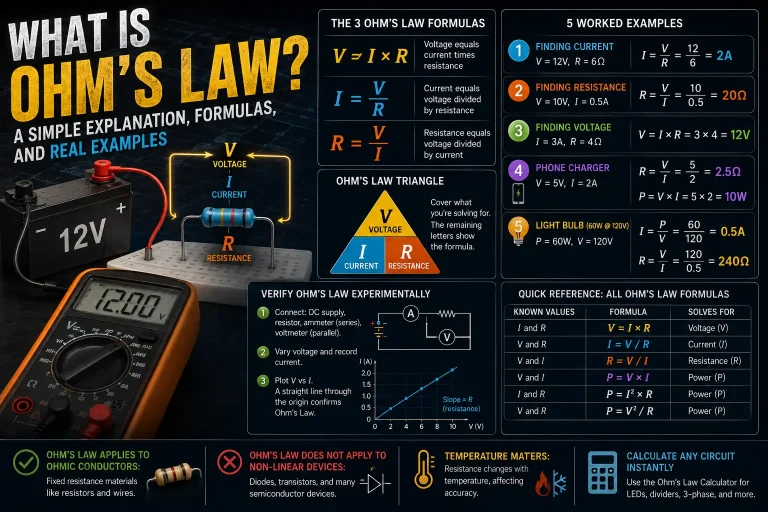
What is ohm law

What Is Ohm’s Law? A Simple Explanation, Formulas, and Real Examples

Ohm’s Law describes one fixed relationship: voltage pushes current through a circuit, and resistance holds it back. Increase the voltage, and current goes up. Increase the resistance, and current goes down. That’s the entire idea; everything else is just the math that makes it precise enough to design real circuits with. This guide breaks Ohm’s […]

Read Article →